A practitioner-developed framework for K–12 educators and leaders

Learning deserves to be noticed before it is measured.

See what students are showing you before the data catches up.

The Pre-Achievement Framework (PAF) helps educators recognize, document, and respond to six observable learner behaviors that can emerge before traditional measures of achievement reflect a student’s progress.

PAF complements academic measures. It does not replace them, predict achievement, or reduce students to another score.

The six observable behaviors

  1. 01Beginning
  2. 02Asking Questions
  3. 03Persisting
  4. 04Revising
  5. 05Taking Ownership
  6. 06Helping Others

Not stages. Not a checklist. Not a prediction model.

What happens before achievement?

Schools have no shortage of data. Much of it tells us what already happened.

Grades, benchmarks, assessments, attendance, and growth measures matter. But they often arrive after a learner has already been struggling, changing, persisting, or beginning to take ownership.

PAF asks a different question: What are students showing us while learning is still unfolding?

These behaviors are not substitutes for academic outcomes. They are early evidence that a student’s relationship with learning may be changing.

Notice the signs. Name the evidence.

Broad labels can hide the learning behavior underneath.

Schools and families are often encouraged to notice when a student is struggling, excelling, disengaged, or “not motivated.” Those signals matter—but labels alone do not tell an educator what the student is actually doing or what support might help next.

PAF gives educators and families a more precise language for what to notice before those signs become outcomes.

Interpretation
“The student is not motivated.”
Observable evidence
“The student began after one prompt, then stopped when confused and did not ask for clarification.”

When adults name what they can observe, they can choose a more precise response.

1classroom context
114survey submissions
95unique respondents
6observable behaviors

Professional Learning for Schools & Districts

Help educators notice more before the next score arrives.

PAF professional learning helps educators move from understanding the six behaviors to practicing observation, documentation, reflection, and response—without creating another student score, label, or compliance system.

Signature session

Before the Score: Seeing and Strengthening Pre-Achievement Behaviors

What might teachers notice if they knew what to look for before the next benchmark, report card, or state assessment? Before the Score introduces the six Pre-Achievement Behaviors and gives educators a practical way to examine learning while it is still unfolding.

The goal is simple: notice more, claim less, and respond better.

Participants will leave able to:

  • Recognize the six observable Pre-Achievement Behaviors.
  • Distinguish observable evidence from interpretation.
  • Use student voice and observation to ask better questions.
  • Examine AI-supported learning without confusing completion with learning.
  • Identify practical instructional responses without lowering rigor.

Three ways to engage

Clear offers. Practical outcomes.

Virtual leadership session

Pre-Achievement Leadership Briefing

$1,500

A focused 60-minute virtual conversation for superintendents, cabinet teams, principals, instructional leaders, and AI working groups exploring whether PAF fits their priorities.

  • 60-minute facilitated leadership briefing
  • Leadership reflection guide
  • Discussion of potential school or district applications
  • Recommended next steps based on your team’s priorities
90-day implementation

District Launch Partnership

$9,500

A guided implementation experience for a district team and up to three schools ready to test PAF in authentic practice.

  • Readiness and goals session
  • Leadership briefing and Before the Score workshop
  • PAF observation cycle
  • Two implementation coaching sessions
  • Customized look-fors and 90-day roadmap
  • Closing review: continue, adapt, pause, or stop

Start where it makes sense

If PAF aligns with something your school or district is already working on, let’s talk.

You do not need to commit to a districtwide initiative to explore the framework. Some organizations begin with a leadership conversation. Others start with a staff workshop. The right starting point depends on the questions your team is trying to answer.

In-person travel and lodging are billed separately at cost. A 50% deposit reserves the engagement date. Additional schools, sessions, or participant groups may be quoted separately.

From framework to practice

PAF is moving from proof of concept toward a usable practitioner model.

The next question is not simply whether the idea makes sense. It is whether educators can use PAF to notice something meaningful that they might otherwise have missed—and respond more intentionally because of it.

01 · Notice

Recognize what the learner actually does.

Look for observable evidence of beginning, questioning, persisting, revising, taking ownership, or helping others.

02 · Document

Capture patterns without creating another score.

Record what happened, when it happened, and the context around it before moving to interpretation.

03 · Interpret

Use evidence to generate better questions.

Consider student voice, context, access, relationships, task design, and patterns over time.

04 · Respond

Adjust support without lowering rigor.

Use feedback, questioning, modeling, scaffolding, or strategic independence to meet the learning need.

05 · Revisit

Keep observing how the learner changes.

Return to the evidence over time rather than treating one observation as a permanent label.

The MVP test

PAF should work even when Wendell Mosby is not in the room.

Current classroom implementation is being used to refine behavior definitions, observation practices, practitioner tools, feedback language, and reflection protocols so other educators can test, challenge, refine, and apply the framework.

The framework

Notice learning while it is still unfolding.

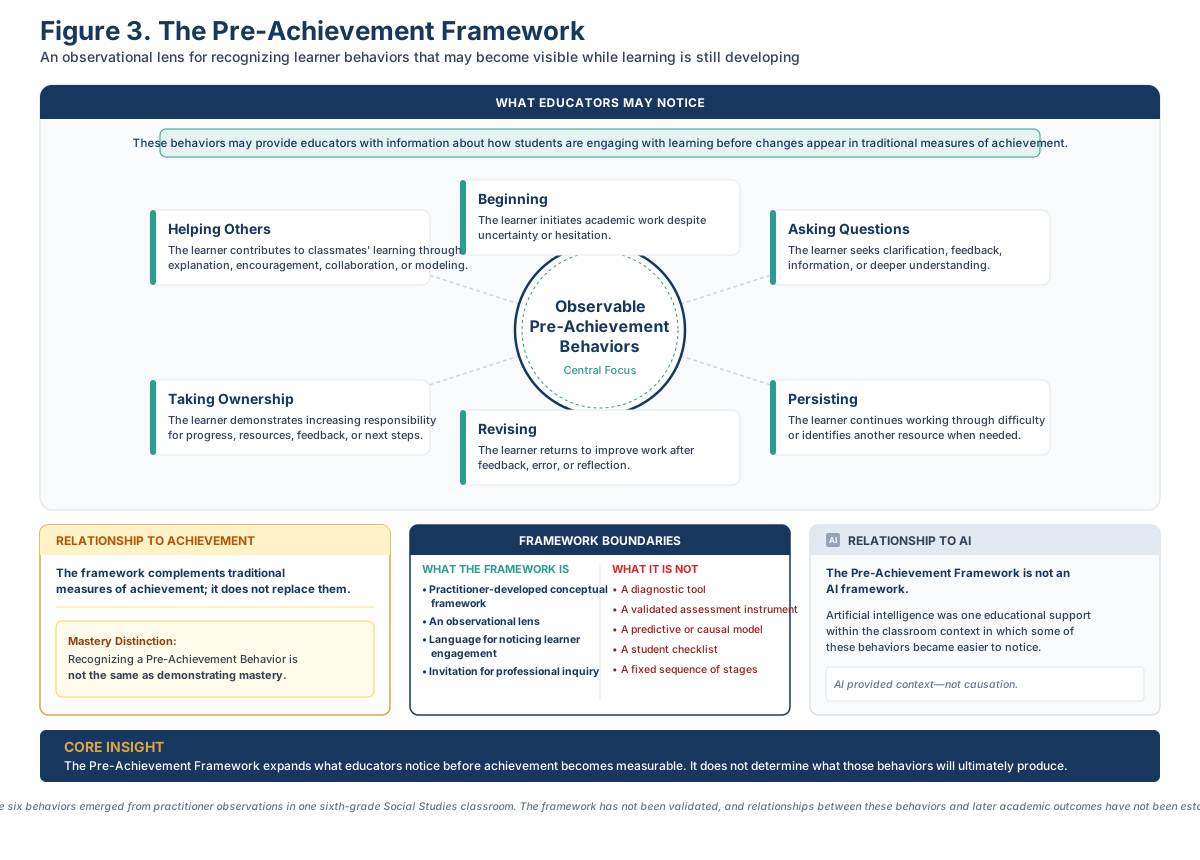
The Pre-Achievement Framework organizes six observable learner behaviors repeatedly noticed during this practitioner inquiry. It complements traditional measures of achievement by drawing attention to forms of learner engagement that can appear earlier.

The Pre-Achievement Framework showing six non-sequential observable behaviors: Beginning, Asking Questions, Persisting, Revising, Taking Ownership, and Helping Others. The figure states that the framework complements achievement measures and is not diagnostic, predictive, causal, or a checklist.
Figure 3 from Beyond the Achievement Gap. The relationships shown are conceptual rather than causal or sequential.

Six Pre-Achievement Behaviors

A language for what educators may already be seeing.

Each behavior describes something observable. Students may demonstrate different behaviors in different combinations depending on the task, setting, relationships, and supports available.

01

Beginning

The student initiates academic work rather than remaining immobilized by uncertainty, confusion, or hesitation.

02

Asking Questions

The student seeks clarification, feedback, additional information, or deeper understanding in order to move forward.

03

Persisting

The student continues despite difficulty, uncertainty, frustration, or an unsuccessful attempt—and may recognize when support is needed.

04

Revising

The student returns to work after feedback, an error, or reflection and makes an effort to improve it.

05

Taking Ownership

The student shows increasing responsibility for progress, feedback, resource selection, missing work, or deciding what to do next.

06

Helping Others

The student contributes to classmates’ learning through explanation, encouragement, collaboration, modeling, or an appropriate strategy.

Framework boundaries

Observation without overclaiming.

The framework is designed to help educators notice more of the learning process. It does not lower academic expectations or turn early behaviors into proof of mastery.

What it is

  • A practitioner-developed conceptual framework
  • An observational lens
  • Language for noticing learner engagement
  • An invitation for professional inquiry

What it is not

  • A diagnostic tool
  • A validated assessment instrument
  • A predictive or causal model
  • A student checklist
  • A fixed sequence of stages

About the inquiry

It began with a classroom question about AI. The students changed the question.

The report draws on classroom observation across the 2025–2026 school year, a spring 2026 student AI-use survey, reflective practice, and professional dialogue.

The survey generated 114 submissions between April 1 and May 22, 2026. After duplicate cleaning and reconciliation, the analysis represented 95 unique respondents. Follow-up AI-use analyses were limited to the 69 respondents who identified themselves as AI users in the first survey question.

What happens before achievement that educators may not be noticing?

01Classroom Observation
02Student Voice
03Practitioner Reflection
04Framework Development
05Future Research

Then back to the classroom.

PRACTITIONER INQUIRY REPORT

Beyond the
Achievement Gap

What My Middle School Students Taught Me About Learning in the Age of AI

Wendell D. Mosby 2026

Foundational report

Read the inquiry that introduced the framework.

Beyond the Achievement Gap documents the classroom observations, student survey findings, Composite Classroom Portraits, conceptual development, limitations, and future-research questions that led to the Pre-Achievement Framework.

“Achievement tells us where students arrived. Pre-Achievement Behaviors may help us notice how they are beginning to get there.”

About the founder

Wendell D. Mosby

Wendell D. Mosby is an educator, author, practitioner-researcher, and creator of the Pre-Achievement Framework. PAF grew from his work as a middle-school classroom teacher and a question that became increasingly difficult to ignore: What happens before achievement that educators may not be noticing?

Drawing on classroom observation, student voice, reflective practice, and more than two decades of work across education, youth development, nonprofit leadership, and community engagement, Wendell explores the intersection of student agency, educator observation, artificial intelligence, and the learning behaviors that can emerge before traditional measures fully capture growth.

His goal is not to replace academic measures. It is to help educators see more of the learning process while there is still time to respond.

The invitation

Observe. Question. Test. Refine. Keep learning.

The framework is offered as a beginning rather than an endpoint—something to be examined, challenged, refined, and investigated across other classrooms and contexts.